Pearson Edexcel · GCSE · Psychology
Course version: 1PS0 · Version from Sept 2017
Understand the role of internal and external influences on the self and…
Full specification wording
The self: 7.1.4 Understand the role of internal and external influences on the self and self-esteem, including: a. temperament b. experience
The development of the self and self-esteem is shaped by internal and external influences.
Checked against the Pearson Edexcel 1PS0 specification (opens in a new tab) on .
- Point 4 of 6
- 4 key terms
Study notes
From the checked teaching notes for this specification point.
The idea
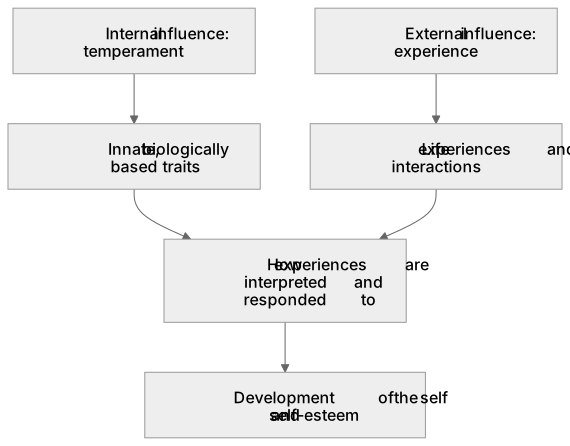
The development of the self and self-esteem is shaped by internal and external influences. Internal influences include temperament, which refers to innate, biologically based traits we are born with, such as being naturally outgoing. A child with an easy temperament often receives positive reactions, boosting self-esteem. External influences involve our life experiences and interactions. For example, a student who experiences repeated success or receives consistent praise is likely to develop higher self-esteem than someone facing frequent criticism. Understanding both factors is crucial because they interact; an individual's innate temperament can significantly affect how they interpret and respond to their external experiences.
What earns the marks
- Identify temperament as an internal, biological influence on the development of the self.
- Explain how specific temperaments can positively or negatively affect an individual's self-esteem.
- Identify life experiences, such as parenting styles or peer interactions, as external influences.
- Describe the interaction between internal temperament and external experiences in shaping self-concept.
Common mistakes and how to put them right
Confusing internal and external influences.
Put it right: Temperament is internal and innate, while experiences are external and environmental.
Assuming temperament is learned.
Put it right: Temperament is biologically based and present from birth, whereas personality develops over time.
Treating self and self-esteem as identical concepts.
Put it right: The self is the overall identity, while self-esteem is the evaluative judgment of one's own worth.
Exam tips
- Use clear examples to distinguish between internal influences like temperament and external influences like experience.
- When evaluating, discuss how temperament and experience interact rather than viewing them in isolation.
- Ensure you can define both 'self' and 'self-esteem' accurately before explaining what influences them.
Try the lesson
The start of the The self: 7.1.4 Understand the role of internal and external influences on the self and self-esteem, including: a. temperament b. experience lesson, made from checked teaching notes for this specification point.
Have a go first
Which of the following is an example of an internal influence on the development of a person's self-esteem?
Listen
The development of the self and self-esteem is shaped by internal and external influences. Internal influences include temperament, which refers to innate, biologically based traits we are born with, such as being naturally outgoing. A child with an easy temperament often receives positive reactions, boosting self-esteem. External influences involve our life experiences and interactions. For example, a student who experiences repeated success or receives consistent praise is likely to develop higher self-esteem than someone facing frequent criticism. Understanding both factors is crucial because they interact; an individual's innate temperament can significantly affect how they interpret and respond to their external experiences. A strong answer earns marks for these points. Identify temperament as an internal, biological influence on the development of the self. Explain how specific temperaments can positively or negatively affect an individual's self-esteem. Identify life experiences, such as parenting styles or peer interactions, as external influences. Describe the interaction between internal temperament and external experiences in shaping self-concept. A common slip: Confusing internal and external influences. Instead, temperament is internal and innate, while experiences are external and environmental. Exam tip: Use clear examples to distinguish between internal influences like temperament and external influences like experience.
See it
Key words
Say what each word means before you turn the card.
Temperament
Try answering aloud or in your head before turning the card.
Experience
Try answering aloud or in your head before turning the card.
Self
Try answering aloud or in your head before turning the card.
Self-esteem
Try answering aloud or in your head before turning the card.
See every definition
- Temperament
- Innate, biologically based traits we are born with, such as being naturally outgoing.
- Experience
- An external influence on the self and self-esteem, involving our life experiences and interactions.
- Self
- The overall identity, as opposed to self-esteem, which is the evaluative judgment of one's own worth.
- Self-esteem
- The evaluative judgment of one's own worth, which can be boosted by positive reactions or consistent praise.
Label the diagram
Some boxes have lost their names. Pick the right name for each number.
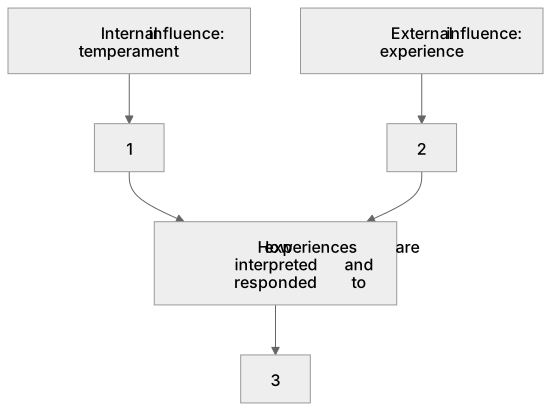
1Box 1
2Box 2
3Box 3
There is more to this lesson
The full lesson goes on to check your understanding and help you earn the marks. Create a free account to carry on, with your progress saved.
A week of Premium from your first lesson · Then the free plan continues · No card, no charge
Test your understanding of The self: 7.1.4 Understand the role of internal and external influences on the self and self-esteem, including: a. temperament b. experience
Active recall beats re-reading. Take an instant quiz now to test what you’ve learned and lock it into long-term memory.
A week of Premium from your first lesson · Then the free plan continues · No card, no charge